The drive from Makkah to Madinah takes 4 to 5 hours with stops, over about 450 km. Prayer stops are part of the fare. A start after Fajr usually puts you in Madinah before the midday prayer. A taxi costs from SAR 400 for the whole vehicle.
The drive from Makkah to Madinah covers about 450 km, and it takes 4 to 5 hours with stops. For most Umrah visits it is the longest road trip. Prayer, children and older travellers all shape the day, so the timing matters more than the distance.
If you have not yet chosen between the train and the road, start with Makkah to Madinah by train or taxi.
The road
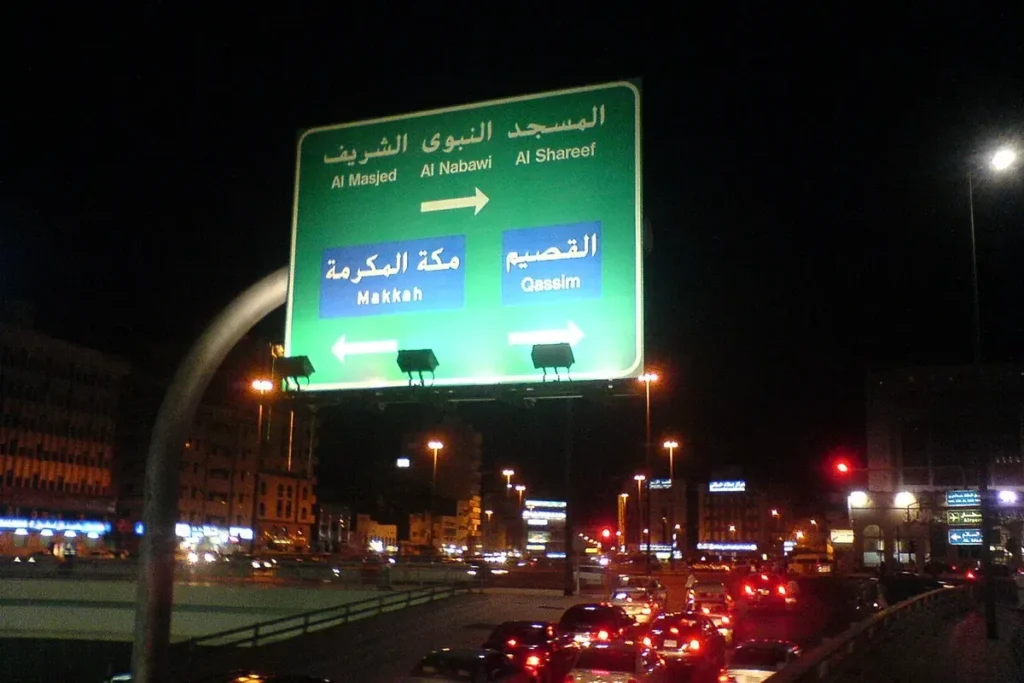
Most traffic between the two cities uses the Hijrah Road, signed as Highway 15. It is a main route for Hajj and Umrah travellers, and the Roads General Authority has upgraded parts of it. The highway is about 421 km long. We plan with about 450 km, since the exact start and finish inside each city add to the total.
Long stretches of the road are a multi-lane highway, with service stations beside it.
How long it takes
We plan 4 to 5 hours for Makkah to Madinah, and the same for the way back. These things move the time:
- Traffic leaving Makkah. Leaving the city can take half an hour.
- Prayer stops. They are in the fare, and each one adds time.
- Rest stops. Children, older travellers and drivers all need them.
- Season. Ramadan and the weeks around Hajj are slower.
- Weather. Summer heat is hard on vehicles and passengers. Rain and dust can slow the road.
Fares for each direction are on Makkah to Madinah taxi and Madinah to Makkah taxi.
When to leave
There is no single best time. Each choice has good and bad points.
| Leave | Good | Watch for |
|---|---|---|
| After Fajr | Cool road, you arrive before Dhuhr | A very early start for children |
| Mid morning | Easy check out at the hotel | Heat builds from late morning |
| After Dhuhr or Asr | You pray in Makkah first | You arrive in the evening, and hotel check in is later |
| Late night | Quiet road | Tired travellers, harder to rest properly |
Hotel check in and check out times usually decide the day. Ask both hotels for their rules before you fix the time. Your driver can then help you choose.
Prayer on the way
On our intercity runs the driver stops for prayer, and it costs nothing extra. Tell him which prayer is coming up, and he plans the stop. The highway has rest areas and fuel stations along the way, and your driver stops at one of them for prayer.
Many travellers ask if they may combine or shorten prayers on the road. That is a religious question, and the answer depends on your school of thought and your situation. Ask your group leader or a scholar before you leave. Then tell the driver what you need.
Rest stops and food
Plan a stop every 1 to 2 hours if you travel with children or older relatives. Use the stop to walk, drink water and use the facilities.
- Water. Carry bottled water in the vehicle. It is hot in much of the year.
- Food. Light food is better than a large meal before a long drive.
- Medicines. Keep them in your hand bag, not in the boot.
- Phone. Charge it before you leave, and bring a power bank.
You can stop at Badr, a historic place on the way, on a separate fare. The stop is up to 45 minutes, and the trip takes about 1.5 to 2.5 hours longer. See Makkah to Madinah taxi and the Badr guide. Other stops added on the day are charged separately, so ask when you book.
The miqat if you travel the other way
Ihram is the state of dress and intention for Umrah, and men wear two white cloths. A miqat is a fixed point on the way to Makkah, and you must be in ihram before you pass it. If you drive from Madinah to Makkah for Umrah, you may enter ihram first at Dhul Hulayfah, the miqat on the Madinah side.
Our Madinah to Makkah taxi can stop here if you ask when you book. Where you enter ihram is for your group leader or a scholar to decide, so check before you travel.
On the Makkah to Madinah drive there is usually no miqat stop, because most passengers have finished Umrah.
Before you leave the hotel
A few minutes of checking saves a long delay on the road.
- Bags. Count them at the hotel door. The driver loads them, and you check the count at the Madinah end.
- Hand bag. Keep ID, phone, medicines and water within reach.
- Check out. Settle the hotel bill the night before, because queues at the desk can delay the start.
- Madinah hotel. Check the name and the area, and ask when your room is ready. A very early arrival may mean waiting.
Arriving in Madinah
The road ends near Masjid an-Nabawi, the Prophet’s Mosque, and the hotels around it. At prayer times the roads near the mosque are controlled. The driver may stop at the nearest open point, and the hotel porter carries your bags from there.
Tell us the full hotel name and your plan for the first prayer, and we time the arrival around it.
You may travel on later in your stay, by air or by the high speed train known as the Haramain train. See Madinah Airport transfers and Madinah Haramain station taxi.
Choosing a vehicle for four to five hours
The longer the drive, the more a good seat matters.
- Two or three people. A Camry or Sonata is the lowest fare. See Toyota Camry.
- A family with bags. The Staria has sliding doors and room for luggage. See Hyundai Staria.
- Older travellers. A high seat is easier to get into, and the GMC Yukon XL has one. See GMC Yukon XL.
- A group of 9 to 11. One Hiace takes the whole group. See Toyota Hiace.
For more on older travellers, read Umrah with elderly parents.
Questions people ask
About 4 to 5 hours with stops, over about 450 km.
Yes. Ask the driver to stop, and the stop is in your fare.
Yes, on a separate fare, with a stop of up to 45 minutes. See the Badr guide.
No. Each fare covers one vehicle for your own party, and we do not sell single seats.
The fare starts at SAR 400 for the whole vehicle, so a family pays the same as one traveller. Each bigger vehicle has its own fare. Today’s figures are on routes and prices.
Book the drive
Tell us your two hotels, the date and the number of travellers on WhatsApp, and the fare comes back in writing. The booking page works too.